
The Search For Margery King (Appendix II for the book, San Francisco's Hottest Cold Case)
We finally found my dad's girlfriend and eyewitness to his murder

New Appendix, soon to be added to San Francisco’s Hottest Cold Case
**best understood if you’ve read the book**
Our family has been trying to track down my dad’s girlfriend, Margery King, for more than 40 years. Homicide Inspector Falzon never put us in touch with her, and neither did any of his successors. Every one of them claimed that they tried. They said they relayed our messages to Margery and told her that we were looking to talk to her, but they claim she told them she wasn’t interested, that she didn’t want to hear from us.
Our search for her grew more intense after we got to look at the case file in 2010 and discovered that the San Francisco Police Department (SFPD) had been lying to us all along, about everything. To this day, they insist that Margery had seen nothing and had nothing of value to add to the investigation, when in fact, she did. She was their most important witness. She was the last person to see Andy alive and got a good look at his killer minutes before the murder.
Margery told Falzon that Eugene had been strong-arming Andy for weeks and that Andy told her he’d be killed soon over a money debt. I now believe that Margery told Falzon more than what he wrote down in her statements. I’m convinced that his cover-up started as soon as he arrived at the crime scene or shortly thereafter, and that he was very careful of what he put down in his notes. He paraphrased a lot of what people were telling him, not using their exact wording, so that they could be interpreted in different ways. Falzon told me that he knew Eugene was the killer as soon as he arrived at the crime scene. How he knew, he can’t seem to remember, much less explain to me.
I’m convinced that other witnesses named Eugene that night, and Falzon later removed those statements from the case file, or didn’t write them down in the first place. I’m also convinced that Falzon knew all about Eugene. He knew who he was, he knew his reputation and proclivity for violence, and he knew that he was connected to the mob. He likely knew of the threats to Andy from word on the street, and about the deal that had gone bad, and all parties involved.
My sister, Lori, and I have long known that Margery King is the single most important witness in this case. She held all of the answers. We never stopped looking for her. We never gave up. We both followed lead after lead, only to end up empty-handed and with a trail grown cold.
Police rely heavily on informants. I’m sure that the violent feud between Andy and Eugene was on his radar long before the murder. The entire neighborhood knew, even before his body went cold, that Eugene had murdered him. Including Falzon by his own admission. So, when Margery gave her first statement and told the homicide investigator that Andy had been confronted and threatened by a man in front of her, Falzon knew that Margery could identify that man as Eugene in a line-up.
When Falzon put out the All Points Bulletin (APB) that night, he stated that the killer had an argument with Andy minutes before the murder and that he “should have blood on his clothes.”
It always confused me why he didn’t call Margery in for a lineup to see if she could identify Eugene as the man who confronted Andy on the street before he was murdered. Well, I’ve concluded that he didn’t have to, because Margery must have told Falzon that it was Eugene from the beginning.
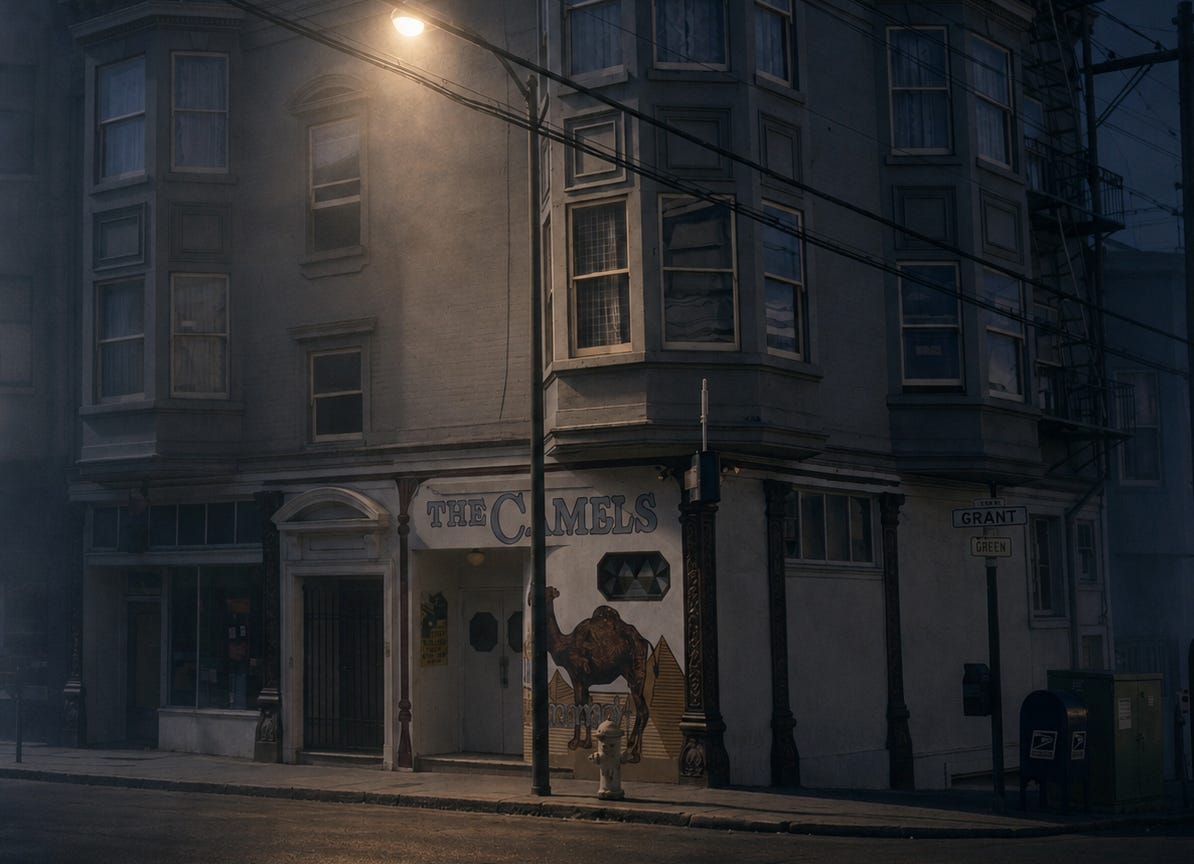
Margery had been Andy’s girlfriend for a year. She was living with him at his apartment. Eugene was known to hang out at the Camel bar downstairs. He also frequented all of the other North Beach bars that they hung out in. There’s no way that she didn’t know who Eugene was. I believe she told Falzon that it was Eugene who confronted Andy that night, and that’s why Falzon never conducted a lineup. He didn’t have to. She already identified him as the killer.
Now, as I said, I believe the cover-up started the minute Falzon showed up at the crime scene. He was being very careful about what he wrote down when interviewing witnesses. Margery’s eyewitness statement lacks any real detail. It mentions that threats were hurled at Andy, but the only one written down was, “I won’t fight you in front of her.”
Are we supposed to believe that’s the worst thing he said? The assailant had a heated confrontation with Andy, following him from one side of the street to the other, making threats, and yelling at Andy about something. And we’re supposed to believe that Falzon didn’t ask Margery what the argument was about. Why didn’t the detective ask her for specifics, like, “What was the guy saying? Did he say what he was angry about? Did he say why he was going to fight Andy?”
The only thing Falzon wrote down, the only quote that he had of this man in a murderous rage, was Eugene threatening Andy with “I won’t fight you in front of her.” It’s ludicrous. I believe that Falzon purposely misquoted her. I believe that Eugene was threatening to kill Andy, which he had done before. “I won’t kill you in front of her” sounds more like it
Margery grew so terrified over this confrontation that she took off. She ran away at two in the morning to catch a 45-minute bus ride to her sister’s apartment on the other side of town, which is a pretty extreme reaction to some random guy saying he wanted to have a fistfight with Andy. Brawls were an hourly occurrence in that neighborhood on a Saturday night. Why didn’t she just go to her apartment if she wanted to avoid watching a fight? All she had to do was walk upstairs and lock the door.
If you know Eugene’s backstory, you’d know he would have no problem fighting Andy in front of his girlfriend. Killing him in front of her, yes, but fighting him, no. The man routinely fought people in front of a crowd. He lived for it. He didn’t care who was watching. He had no problem attacking and fighting police officers. He had no problem beating his wife with a hammer outside of a crowded restaurant. He gutted a dog with his knife in front of children. This guy was not afraid to fight anytime, anywhere.
A couple of weeks after the murder, Eugene confronted one of the witnesses, one of my dad’s roommates, at The Saloon and threatened to kill him in front of witnesses. When the guy talked back to him, Eugene nearly took his head off with a golf club that he was carrying as a walking stick. And we’re supposed to believe that he didn’t want to fight Andy in front of his girlfriend on a dark street corner in the middle of the night?
Within days of Margery officially identifying Eugene as the killer, by name, making sure it was on record, she decided to run again. She left California to move to her parents’ house in Florida, where she could feel safe. Eugene was threatening to kill Andy’s roommates and anyone who talked to the cops, so I’m sure he threatened to kill Margery, the eyewitness who was able to put him at the scene of the crime, making death threats.
The fact that Eugene was never brought in for a line-up to be identified by Margery is one of the strongest proofs of a cover-up in this case. Falzon never intended to solve this murder.
The day before she left for Florida, she called Andy’s parents and assured them, “Don’t worry, the cops know who killed your son. It’s only a matter of time.” Sadly, she was wrong. But her heart was in the right place.
My sister, Lori, and I have long known that Margery King is the single most important witness in this case. She held all of the answers. We never stopped looking for her. We never gave up. We both followed lead after lead, only to end up empty-handed and with a trail grown cold.
Over the years, I found a few contenders. One lady in Florida with the same name lived in Gulfport, not only in the same neighborhood but also on the same street that Margery told Falzon her parents lived on. It couldn’t be a coincidence, I thought. I was convinced it was her. The lady had recently died, and I talked to her sister-in-law a few times. Slowly, I counted her out. She had never visited California and certainly had never lived there during the hippie era. And then I found out that her birthday didn’t match. Margery told Falzon that her birthday was April 6th, 1952, and that birthdate was also on her arrest record in San Francisco.
My sister found a “Marjorie” King living in Texas who had the same birthday. She was convinced it was her. But I had my doubts. My sister sent a few messages on Facebook to this lady, and she didn’t respond. I also sent a couple of my own, and she didn’t respond to me either. I then contacted a few of her family members. I asked the lady’s sister if she would speak to her and tell her who I was and that I wanted to know if she was possibly my dad’s ex-girlfriend. She told me she’d ask her sister, and then she stopped responding. None of her other friends or relatives would respond to my private messages, no matter how I worded them.
So, I was left wondering. Was she not the right person, and thought I was trying to pull some kind of scam? Or was she the right person and didn’t want to talk about Andy or anything that happened?
Her unresponsiveness made my sister even more convinced it was her. She said, “They have the same name and birthday; it has to be her.” But I began to lean more toward my doubts. I still had unanswered questions. I had also come close to finding her before, and I needed more to believe we had the right Margery King. Sharing a birthdate could have just been a coincidence. It happens.
Besides that, there were a few sticking points that needed to be resolved.
On the witness statements taken by Frank Falzon and on her San Francisco arrest records, Margery King was listed as a WFA (White, Female, Adult). The lady Lori found on Facebook was 100% Native American. She should have been listed as an IFA (Indian, Female, Adult) by the SFPD, and she wasn’t. And there’s no way anyone would mistake this lady for a white female.
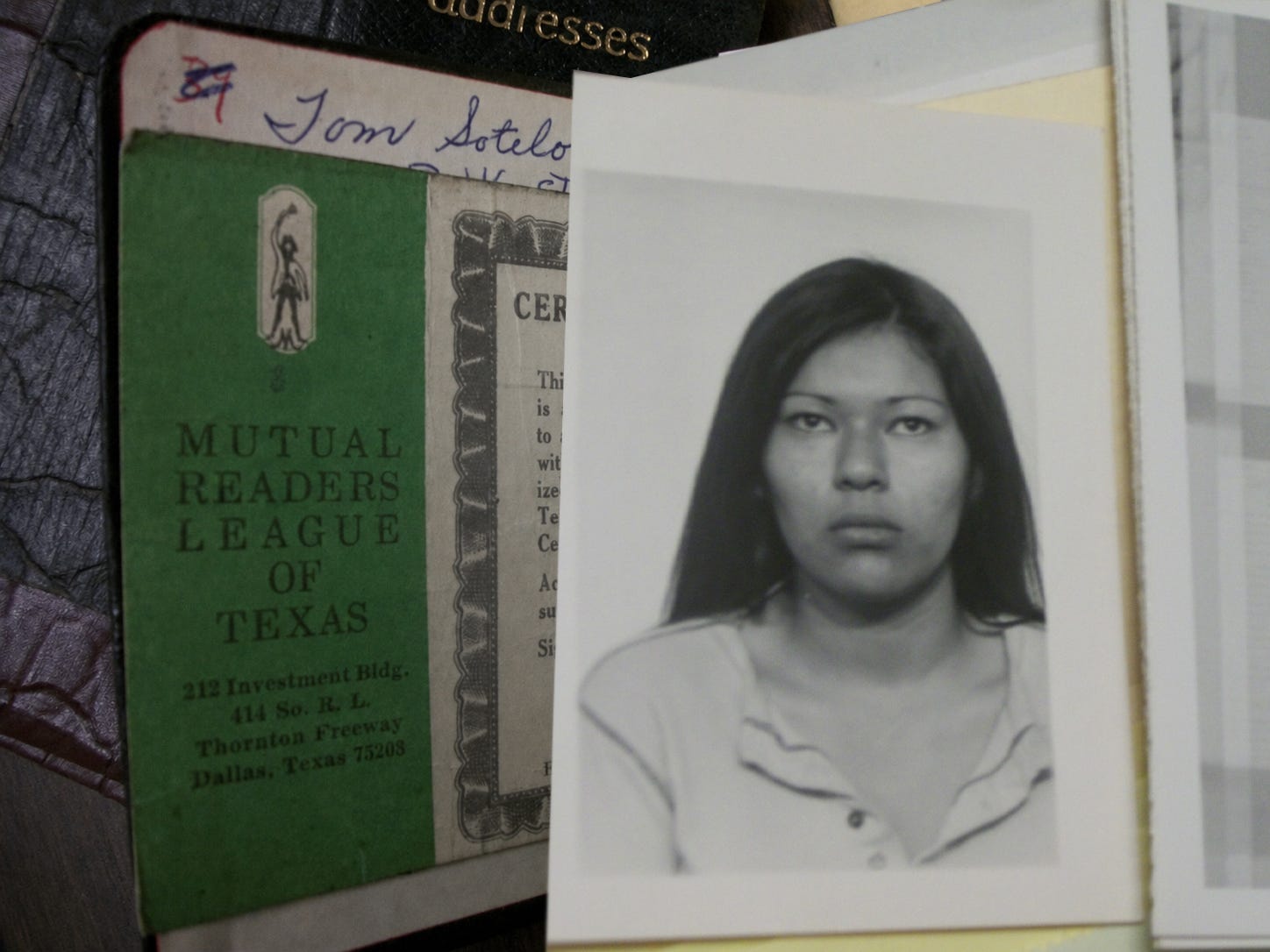
Lori reminded me of a loose photo we found in our dad’s case file. It was of a young 20-something Native American woman who could have passed as a young version of the 70-year-old lady on Facebook. I took note of it and put it in “her column” as a possible photo of Margery. But there was a good chance that it wasn’t her. The photo could have been a photo of a witness or even someone not related to the case at all. The case file was in such disarray that there was no way of knowing how the photo got in there or why it was in there.
Another big hurdle for me was the fact that the lady on Facebook spelled her name differently. The lady that we were looking for spelled her name M-A-R-G-E-R-Y. That’s how Falzon wrote it down. That’s how Andy wrote it down in his little black book. And that’s how it was spelled on an arrest record I saw in the case file. Additionally, she also went by Margaret, which she wrote down on a court paper, and Andy wrote inside one of his notebooks. So, I assumed her name was Margaret and her nickname was Margery.
The lady on Facebook spelled her name M-A-R-J-O-R-I-E and her nickname was Margie. She wasn’t a Margaret like the girl in San Francisco; she was a Marjorie, and her nickname was Margie, which the girl in San Francisco didn’t use.
I was hung up on this for about two years and needed to have it resolved before I could believe it was the right Margery. I felt that it could easily be a coincidence that this lady on Facebook had the same birth date and a similar name. My sister thought I was being stubborn and pigheaded, so it caused a lot of tension as I continued my search for Margery King.
I never gave up on Lori’s find. I kept trying to put the pieces together so that I could count this woman out or count her in. I didn’t like it being unresolved. When I compared the photo of the young Indian girl to the old Indian lady, they looked somewhat alike, but their noses were completely different. The older woman’s nose was nearly twice the size of the young woman’s. And sure, I was aware that noses can grow in size over the years, but it was such a marked difference that it fed my doubt.
Every so often, I’d check the lady’s profile on Facebook and send her another note, only to be ignored. My sister also attempted a few more times. Then the woman became ill. There were photos of her in a hospital and then she passed away. If she were the woman we were looking for, then we’d never be able to speak with her. It was very depressing. Our most important and consequential questions would never be answered.
Shortly after she passed, I noticed a few new people posting on her Facebook profile. I noticed that a daughter I hadn’t seen before posted a public comment, and I asked her if I could contact her. She agreed.
The daughter turned out to be the lady’s stepdaughter. I started out by asking her if her mother lived in San Francisco in the late ’60s or early ’70s, and surprisingly, she said she did and that she was a Flower Child back then. She instantly volunteered that Marjorie told her “something really bad happened” while she was living there, and that she left the city and never went back. She said her mother never told her exactly what happened.
I filled her in on our story and asked her if she could talk to her family members. We’d be interested in anything they heard about her time in San Francisco. She said she would ask her dad and siblings. Some time later, she got back to me and told me that her mother didn’t talk about her past. She had a hard childhood and ran away from a foster home at thirteen. She said that Marjorie wanted to forget everything in her past and that the family respected her boundaries. They never pressed her on it. Her background, her childhood, and everything that happened up until she started her new life were unknown to her family.
All of this, of course, bolsters the position that it was probably her, that this was the woman that we had been looking for forever.
I asked Marjorie’s daughter if she could find some old photographs of her. I wanted to compare them to the old photo I had because the only photos on her Facebook profile were recent. I wanted something closer to the early 1970s to compare. She looked for photos and got back to me. The oldest ones she had were from the mid-1990s. It was better than nothing, but the difference in the size of her nose was still throwing me off.
I happened to run across a picture of Marjorie’s granddaughter, and her nose looked exactly like the lady in the old police file. And then I got the bright idea of trying to find a computer program or app that could compare the photos using facial recognition. Why hadn’t I thought of it before? I found that a few of these apps were available. So I ran the new photo along with the old one, and three of the four apps said that it was the same person in the photos. So that is what finally convinced me it was her.
In all probability, we found my dad’s girlfriend, Margery King. And sadly, she was so traumatized by what happened and was still so scared that she couldn’t bring herself to talk to us and tell us what she knew. I mentioned to her family early on, when I was trying to contact her, that the killer was dead, so she didn’t have to fear him. But who knows, maybe she was afraid of the corrupt San Francisco Police Department and/or others involved in the murder who have never been named.
I finally reconciled why she spelled her name differently when she was living in San Francisco. I believe that she moved to San Francisco as a runaway during the Summer of Love in 1967 when she was 15. Like so many others, she changed her name slightly to throw off anyone trying to find her, like her foster family. If they looked up her name in the phone book or if she got in trouble with the cops, her name “Marjorie” would not be found.
So that’s the end of our search for Margery King and how it turned out.

⭐⭐⭐⭐⭐ “I am an avid reader of mob and true crime novels. This is one of the best I have ever read.” - Amazon review
⭐⭐⭐⭐⭐ “What a page turner! This story is an amazing piece of investigative work—both compelling and heartbreaking.” - Amazon review
⭐⭐⭐⭐⭐ “I’d seen the author’s work in OZY but was blown away by this book. It’s SUCH a great read, written from the heart! Full of interest for those historians of the hippie generation, North Beach, corrupt cops, mobbed up pols, and San Francisco in general. Very well written and paced up to the last pages. Truth is indeed stranger than fiction. Buy this book now!” - Amazon review